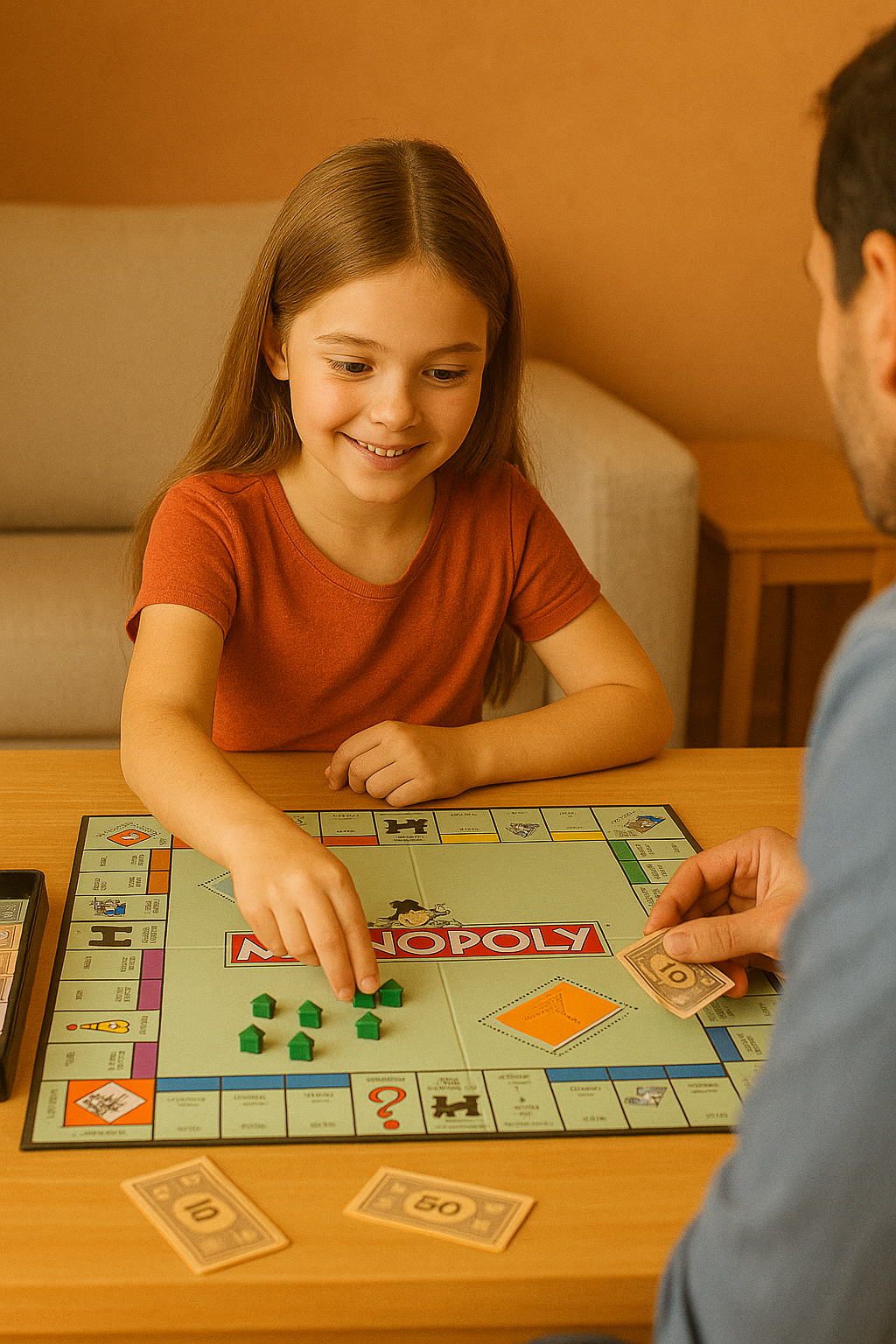
Discover how games like Monopoly teach kids about money, choices, and saving — helping them build financial confidence through play.
Learning About Money Should Be Playful
Talking about money with kids can feel awkward for many parents.
We often think financial lessons need charts, budgets, or lectures — but what if learning about money started with laughter and a few dice?
Games like Monopoly, The Game of Life, or even a homemade “shop” using play money can turn complex ideas into something kids truly understand.
And the best part? Research shows this kind of learning through play actually works.
According to the University of Cambridge (2013), children start forming money habits as early as age seven.
That means what they learn — and experience — before that age plays a big role in how they’ll handle money later.
Why Early Money Lessons Matter
Before children can even count properly, they start noticing how adults use money.
They see you tap your card, pay for groceries, or say “we can’t buy that today.”
These small moments build what researchers call “money scripts” — beliefs about spending, saving, and value that shape how they’ll use money later in life.
The OECD (Organisation for Economic Co-operation and Development) found that financial education is most effective when it starts early and feels relevant.
That’s where money games come in — they make money real, without risk.
What Kids Learn From Monopoly
Monopoly might look like simple fun, but beneath the surface, it’s a crash course in financial decision-making.
Here’s what kids actually practice:
- Budgeting: Managing limited money while wanting more properties teaches prioritization.
- Risk and reward: Every purchase (or gamble) leads to a new outcome — some good, some not.
- Delayed gratification: Waiting for the right opportunity pays off more than spending quickly.
- Math and counting: Constant addition, subtraction, and change reinforce early numeracy.
- Negotiation and communication: Trading properties and making deals teach persuasion and fairness.
Each round of the game shows how money flows — it enters, it leaves, and if you’re smart, it grows.
A study from the Journal of Economic Psychology (2018) found that simulated money environments improve children’s ability to connect effort with reward, a key factor in lifelong financial discipline.
The Science of Learning Through Play
Educational psychologists agree that children learn best when they’re emotionally engaged.
According to the Child Mind Institute, play activates multiple parts of the brain — improving memory, attention, and reasoning.
When kids touch, count, and exchange pretend money, they’re not just playing — they’re building cognitive pathways linked to planning, self-control, and cause-and-effect thinking.
In plain words: fake money builds real understanding.
Games like Monopoly also teach emotional control. Losing money (even fake money) can trigger frustration.
Learning to handle that calmly helps children develop resilience — a skill that matters just as much as math.
Beyond Monopoly: Other Money Games That Teach
While Monopoly is the classic, other games offer fresh ways to learn about money.
Here are a few examples backed by educators:
1. The Game of Life
Teaches long-term thinking.
Kids see how choices — education, family, jobs — affect income and happiness.
Recommended by the National Financial Educators Council (NFEC) as a tool for early financial literacy.
2. Pay Day
Focuses on budgeting and saving over short periods.
Each round represents a month — perfect for explaining regular income and expenses.
3. Cashflow for Kids (by Robert Kiyosaki)
Introduces investing concepts in a child-friendly way.
Helps kids distinguish between “assets” and “liabilities” — ideas many adults struggle with!
4. Homemade Store Game
You don’t need to buy a game. Let kids set up a pretend shop using real prices and fake money.
It builds real-world awareness — and it’s fun to play together.
What the Research Says
There’s a growing body of research supporting the power of play in financial education:
- The OECD’s “Financial Education for Youth” (2020) report found that games improve motivation and memory retention in financial topics by up to 35%.
- The University of Cambridge study showed that early experiences with money — even pretend play — create mental “money maps” that guide future behavior.
- The University of Chicago’s Center for Decision Research found that children who learn through interactive games develop better self-control when handling money later.
In other words, these games are more than entertainment — they’re training for life.
How Parents Can Turn Play Into Learning
You don’t need to lecture your kids about money.
The key is to let curiosity do the work.
Here’s how to guide the learning subtly:
- Ask questions while playing.
“What happens if you buy too many houses early?”
“Would you rather save or take a risk?” - Reflect after the game.
Talk about what worked and what didn’t.
“Was it smarter to save your money or spend it right away?” - Connect to real life.
“Remember in Monopoly when you saved up for that property? That’s what saving for a big goal looks like in real life.” - Model the behavior.
Let your kids see you budgeting, saving, and making thoughtful financial choices.
As the Money Advice Service (UK) points out, children learn more from what parents do with money than what they say about it.
Five Real Benefits of Money Games
1. Improved numeracy: Kids who play money-based games score higher in applied math, according to Cambridge research.
2. Better decision-making: They practice weighing options and consequences in every turn.
3. Patience and strategy: Games reward planning ahead, not impulse buying.
4. Emotional awareness: Kids learn that losing money isn’t failure — it’s part of learning.
5. Family bonding: Playing together builds trust, communication, and shared understanding about money.
These aren’t abstract skills — they’re exactly what kids need as adults.
From Play to Practice: Making Lessons Stick
After game night, reinforce the lessons naturally:
- Set a small savings goal. “Remember how you saved to buy Park Place? Let’s save for something real now.”
- Use real coins. Give them physical money to count — it builds tangibility.
- Encourage generosity. Let them “donate” some play money to a jar for charity — teaching that money can do good things too.
The goal isn’t to make every moment a lesson.
It’s to show that money can be something positive — a tool, not a stress.
Why It Works: Money Lessons That Feel Good
Psychologists say learning tied to positive emotions lasts longer.
Games make money safe to explore.
There’s no shame, no fear — just experimentation and laughter.
When kids learn through play, they internalize lessons without realizing it.
They learn that money moves, grows, and disappears — and that smart choices matter.
That’s a foundation no classroom can replace.
Final Thoughts: Play Today, Learn for Life
The next time your family sits down for a board game, remember:
you’re not just passing time — you’re building financial habits that could last a lifetime.
Games like Monopoly, The Game of Life, or even a simple pretend shop teach children to think, plan, and care about money in ways that last.
As research keeps showing, play isn’t a break from learning — it’s one of the best ways to learn.
So roll the dice, laugh together, and let the lessons begin.
Leave a Reply